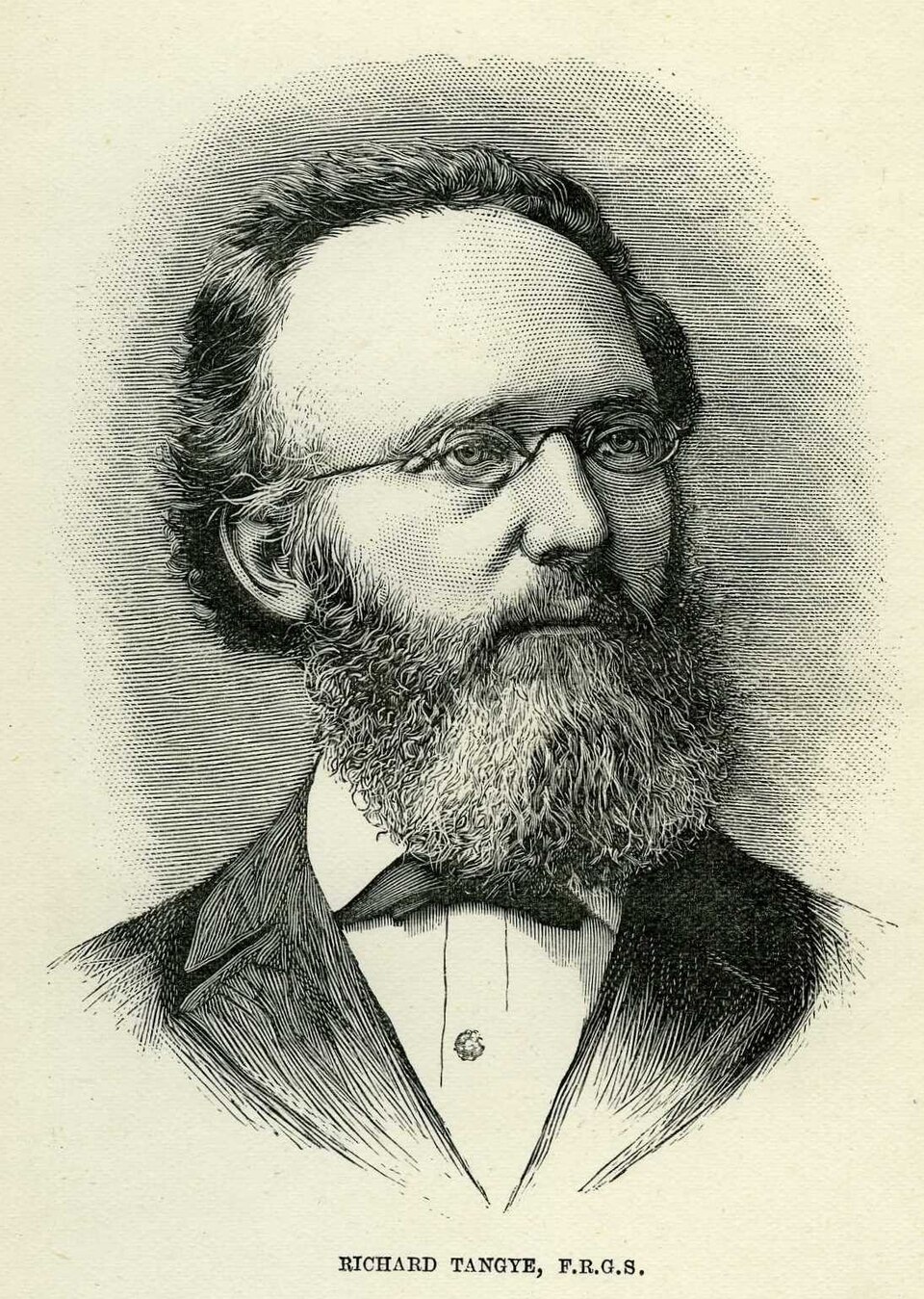
"As a young boy [Richard Tangye] worked in the fields, but when he was eight years old he was incapacitated from further manual labour by a fracture of the right arm. His father then determined to give him the best education he could afford, and young Tangye was sent to the Quaker Sidcot School in the Mendip Hills near the village of Winscombe, Somerset, where he progressed rapidly and became a pupil-teacher.
Tangye disliked this role, and through an advertisement in The Friend obtained a clerkship in a small engineering firm in Birmingham, where two of his brothers, skilled mechanics, subsequently joined him. Here Richard Tangye remained four years, obtaining a complete mastery of the details of an engineering business, and introducing the system of a Saturday half-holiday which he had supported on its introduction by John Frearson, the radical Birmingham Engineer. It was subsequently adopted in many English industrial works.
In 1856, Tangye started business in a small way in Birmingham as a hardware factor and commission agent. His first customers were the Cornish mine-owners in the Redruth district. In March 1857, Richard Tangye, with brothers James and Joseph, started a manufacturing business in Mount Street under the title of James Tangye and Bros. Principally manufacturing hydraulic appliances and particularly lifting jacks, on 31 January 1858, their jacks were successfully employed in the launching of Brunel's steamship SS Great Eastern. Tangye said of the project:
We launched the Great Eastern and she launched us
In 1859, brothers Edward and George joined, together with George Price. The company acquired the patent of the differential pulley-block in 1861, and in 1862 James Tangye invented the Tangye Patent Hydraulic Jack. This resulted in the 1862 purchase and demolition of Soho-located Smethwick Hall, on the site of which was built the Cornwall Works. In 1867 the patent for a new type of Direct-acting Steam Pump was acquired, and in 1870 the company commenced the manufacture of steam engines.
Richard Tangye demonstrated Cornubia, a prototype steam road locomotive, in 1862. It was a passenger vehicle with a capacity of ten persons, including three operators: at the front a driver, who controlled the regulator, reverser and brake, and rider , who steered, with the fireman on a platform at the back. The vehicle weighed 27 hundredweight (1,400 kg) with a maximum speed of 20 miles per hour (32 km/h). Tangye's intention was that it should act as a "feeder" to railways where traffic was thought too sparse to justify the expense of building a line. It performed well, but in 1865 legislation was passed in the UK Parliament to restrict its use: the Locomotives Act 1865 (the "Red Flag Act") limited speed to 4 mph and required a man with a red flag to precede the vehicle on any public road.
The company was commissioned to design the hydraulic systems for the UK's first funicular cliff railway in Scarborough, North Yorkshire, in 1869. After completing another in Scarborough, they employed George Croydon Marks as head of lifts, in which capacity he designed the 1883 Saltburn Cliff Lift, which today is the oldest water-powered cliff railway in the United Kingdom.
In 1872, the two youngest brothers, Richard and George, became sole proprietors. They developed the company internationally, opening offices in Johannesburg and Sydney. The first gas engine, a 1 nominal horsepower two-cycle type, was sold in 1881, and in 1890 the firm commenced manufacture of the four-cycle gas engine. Incorporated as a limited company from 1881, in 1894 they produced their first hot bulb engine. Richard Tangye was knighted in 1894.
Tangye travelled extensively, visiting Australia more than once and also New Zealand and America. He sought to restore his health on the ocean voyages but his main purpose in going to these countries was to expand his business. His accounts of his travels reveal a man who was annoyed that he was not shown the deference by hotel employees that he enjoyed in Britain and who was often unimpressed by the food he was presented with (excluding the fruit, which he greatly liked) - but who enjoyed being recognised and was pleased when he saw evidence of progress e.g. in the establishment of libraries.
Richard Tangye and his brother George were founding benefactors of Birmingham Museum & Art Gallery in 1885, which today has a collection of international importance covering fine art, ceramics, metalwork, jewellery, archaeology, ethnography, local history and industrial history. They also helped found Birmingham School of Art.
Tangye was a noted collector of Oliver Cromwell manuscripts and memorabilia. His collection included many rare manuscripts and printed books, medals, paintings, objets d'art and a bizarre assemblage of 'relics'. The 'relics' included Cromwell's Bible, button, coffin plate, death mask and funeral escutcheon. On Tangye's death, the entire collection was donated to the Museum of London, where it can still be seen today. Items from the Tangye Collection are also to be found at the Cromwell Museum...." 4
------------------------------
In 1851 Richard Tangye, aged 17, born in Illogan Cornwall, apprentice, was under training for a general teacher, at Lidcot School, Winscombe, Somerset.
In January 1857 Richard Tangye of 38 Spring Street, Edgbaston, Birmingham, Warwickshire, commission agent, was granted Administration of his late father's personal estate.
In 1861 Richard Tangye, aged 26, born in Illogan, engine maker, and wife Caroline Tangye, aged 25, born in London, were living in Alston St., Birmingham, Warwickshire.
In 1871 Richd. Tangye, aged 37, born in Cornwall, engineer employing 800 men, and wife Caroline Tangye, aged 35, born in Marylebone Middx, were living in Gower House, Ealing St. Mary, Middlesex. With them were children Mabel (6) of Yardley Worcester, scholar, Harold (5) of Yardley, scholar, Arthur L. (3) of Ealing, and Elsie G. (10 months) of Ealing.
In 1881 Richard Tangye, aged 47, born in Illogan, magistrate & mechanical engineer (employing 14 hundred persons), and wife Caroline Tangye, aged 45, born in Marylebone Middlesex, were living in Solihull, Warwickshire. Present were sons Richard T. G. (5) of Birmingham, scholar, and Wilfrid N. (3) of Bickenhill Warwick.
In 1901 Sir Richard Tangye, aged 67, born in Illogan, mechanical & electrical engineer, and wife Lady Caroline Tangye, aged 65, born in Marylebone London, were living at Coombe Ridge, Kingston Hill, Coombe, Surrey. With them were son Richard T. G. (25), barrister-at-law, and cousin Annie Delaplaine (31) of United States (America).
------------------------------
sir Richard Tangye of Glendorgal Cornwall knight died 14 October 1906 at "Coombe Bank" Kingston-upon-Thames. Probate London 17 December to dame Caroline Tangye, widow, Harold Lincoln Tangye, esquire, and Richard Trevithick Gilberstone Tangye, barrister-at-law. Effects £226,319 6s. 2d. 3


 Research Notes: